A cluttered office can feel overwhelming, with stacks of paper threatening to take over your workspace. When it comes to managing important documents, a 3-drawer filing cabinet is a common and incredibly versatile piece of furniture, perfect for both bustling offices and serene home workspaces. Yet, many find themselves staring at a chaotic mess of papers rather than an organized system. Establishing an efficient filing system isn’t just about tidiness; it’s about reclaiming your time, reducing stress, and ensuring critical information is always at your fingertips. This guide will walk you through transforming your 3-drawer cabinet from a paper purgatory into a professional, easily navigable archive.
Understanding Your 3-Drawer Filing Cabinet
At its core, a filing cabinet is an office furniture staple designed to store paper documents within file folders, keeping them secure and organized. While various sizes and styles exist, the 3-drawer vertical filing cabinet is particularly popular. Its balanced design offers ample storage without consuming excessive floor space, making it an ideal solution for many environments. These cabinets typically feature three deep drawers, each equipped with rails to hold hanging file folders, forming the structural backbone of your organization. Understanding this basic construction is the first step toward optimizing its potential.
The Essential First Step: Purging and Decluttering
Before you can organize anything effectively, you must first clear out the old and unnecessary. This crucial decluttering phase involves confronting every piece of paper in your cabinet and making decisive choices about its fate. Begin by emptying each drawer, laying all documents on a large, clear surface. This visual inventory helps you grasp the sheer volume of paper you’re dealing with.
As you go through each document, categorize it into three piles: “Keep,” “Shred,” and “Recycle.” Be ruthless in your decisions. Many documents, like old junk mail, expired warranties, or user manuals that are readily available online, can be safely discarded. For sensitive information such as old bills, bank statements, or personal records no longer needed for tax or legal purposes, use a cross-cut shredder to protect your privacy. It’s recommended to perform a thorough purge annually to prevent clutter from accumulating and to ensure your cabinet only holds current and necessary information.
Designing Your Filing System: Strategy is Key
With a streamlined collection of documents, the next step is to design a logical filing system. The goal is to create a structure that makes sense to you and allows for quick retrieval. There isn’t a single “best” system, but rather one that aligns with your work habits and the types of documents you handle.
Common filing methods include:
- Alphabetical: Ideal for documents you often search for by name (e.g., client files, vendor invoices, personal contacts).
- Chronological: Best for time-sensitive records, such as monthly bills, project timelines, or receipts that need to be tracked by date.
- Topical/Thematic: Excellent for grouping related materials under broad subject headings (e.g., “Utilities,” “Medical,” “Car Maintenance,” “Projects”).
- Hybrid: Often, a combination works best. You might use a topical system for main categories and then alphabetize or chronologize within those topics.
The key is to keep your main categories simple and broad to avoid creating too many individual files, which can lead to new forms of clutter. Consistency is paramount; once you choose a system, stick to it for all new documents to ensure long-term efficiency.
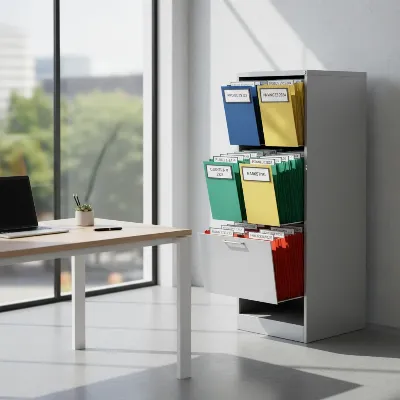 An open 3-drawer filing cabinet with neatly organized color-coded hanging files in an office setting, with a clear desk in the foreground.
Assigning Drawers: A Strategic Approach for 3-Drawers
A 3-drawer filing cabinet offers a perfect opportunity to organize your documents based on their activity level and importance. Assigning a specific purpose to each drawer maximizes efficiency and minimizes searching time.
Drawer 1: Active & Immediate Access
This top drawer should be reserved for your most frequently accessed documents and ongoing projects. Think of it as your “hot” drawer.
- Contents: Current client files, active project documents, daily correspondence, pending invoices, recent receipts, or temporary notes.
- Example Categories: “Current Projects,” “To Do/Action Items,” “Daily References,” “Client A (Active).”
Keeping these items within easy reach reduces the need to dig through less urgent files.
|
Our Picks for the Best Filing Cabinet in 2026
As an Amazon Associate I earn from qualifying purchases.
|
||
| Num | Product | Action |
|---|---|---|
| 1 | 2 Drawer Locking Filing Cabinet | Pre-Assembled Steel Construction | Space-Saving Design is Perfect for Home and Small Office | Letter-Size | Assembled in North America |

|
| 2 | Letaya 3 Drawer Mobile File Cabinet with Lock,Under Desk Metal Filing Cabinets for Home Office Organizer Letters/Legal/A4((Fully Assembled-Black) |
|
| 3 | 2 Drawer Small File Cabinet with Lock, Farmhouse Vertical Filing Cabinet Fits Letter and A4 Size, Under Desk Wooden File Cabinets for Home Office, Printer Stand, Rustic White |
|
| 4 | HOOBRO 2 Drawer File Cabinet with Lock, Under Desk Mobile Filing Cabinet for Home Office, Wooden Farmhouse Office Storage Cabinet, Printer Stand Fits Letter and A4 Size, Walnut and White WH66WJ01 |
|
| 5 | VASAGLE 2 Drawers File Cabinet with Lock, Printer Stand, Office Filing Cabinet Organizer, for A4 and Letter Size Documents, Ink Black UOFC061B16 |
|
| 6 | 3 Drawer Tall File Cabinet with Wheels, Farmhouse Vertical Filing Cabinet Fits Letter/A4 Size, Rolling File Cabinets Wooden Printer Stand for Home Office, Rustic White |
|
| 7 | 3 Drawer Small File Cabinet with Wheels, Farmhouse Vertical Filing Cabinet Fits Letter/A4 Size, Rolling File Cabinets Wooden Printer Stand for Home Office, Rustic White |
|
| 8 | Lorell NuSparc 3 Drawer Locking Filing Cabinet | Pre-Assembled Steel Construction | Space-Saving Design is Perfect for Home and Small Office | Letter-Size | Assembled in North America |
|
| 9 | VASAGLE 2-Drawer File Cabinet, Small Rolling Filing Cabinet for Home Office, Printer Stand, for A4, Letter-Size Documents, 15.7 x 16.5 x 27.6 Inches, Snow White UOFC040W46 |
|
| 10 | VASAGLE 2-Drawer File Cabinet, Small Rolling Filing Cabinet for Home Office, Printer Stand, for A4, Letter-Size Documents, 15.7 x 16.5 x 27.6 Inches, Ink Black UOFC040B16 |
|
Drawer 2: Semi-Active & Household Records
The middle drawer is ideal for documents you need to access periodically but not daily. This might include household management papers or less active business records.
- Contents: Paid utility bills (for the current year), medical records (for the family), vehicle maintenance records, warranties for major appliances, insurance policies, or past project archives.
- Example Categories: “Household Bills (2025),” “Medical Records,” “Vehicle Documents,” “Appliance Manuals.”
This drawer acts as a bridge between your immediate needs and long-term archives.
Drawer 3: Archival & Permanent Records
The bottom drawer is the designated home for permanent records and documents that need to be retained for extended periods, but are rarely accessed. Its position often provides greater stability and can be ideal for heavier legal or tax files.
- Contents: Tax documents (retained for 3-7 years or as required by law), legal documents (deeds, wills, birth certificates, marriage licenses), property records, investment statements, or historical business records.
- Example Categories: “Taxes (2019-2024),” “Legal Documents,” “Property Deeds,” “Investment Records.”
These crucial documents require secure, long-term storage, and the bottom drawer is perfectly suited for this purpose.
Tools of the Trade: Folders, Labels, and Color-Coding
Effective organization relies heavily on the right tools and a consistent approach to their use.
- Hanging File Folders: These are the backbone of any good filing system. They slide smoothly along the rails in your drawers, preventing papers from slumping and creating a clear structure. Use them to define your primary categories.
- Interior File Folders: Nestled inside hanging folders, these are perfect for subdividing your main categories into more specific topics. For example, within a “Medical Records” hanging file, you might have interior folders for “Doctor Visits,” “Prescriptions,” and “Insurance Claims.”
- Color-Coding System: Implementing a color-coded system is a visual game-changer. Assign specific colors to your major categories. For instance, red for “Financial,” blue for “Personal,” green for “Work,” and yellow for “Household.” This visual cue allows for instant identification and retrieval, especially helpful when you commit the corresponding colors to memory.
- Labeling Best Practices: Clear, concise, and consistent labeling is non-negotiable.
- Use a label maker for a professional and legible look.
- Ensure labels are brief but descriptive (e.g., “Mortgage Statements,” not “Bank Stuff”).
- Place labels uniformly on the tabs of both hanging and interior folders so they are easy to scan.
- Consider creating an index or table of contents for more complex systems, especially for your archival drawer, detailing the categories and subcategories within.
Step-by-Step Organization Process
Once you’ve decluttered and established your system, it’s time to implement.
- Empty and Clean Your Cabinet: Remove any remaining dust or debris from the drawers. Ensure the hanging file rails are clean and functional.
- Sort Documents into Piles: Take your “Keep” pile from the purging stage and sort documents into the main categories you’ve defined (e.g., “Finances,” “Personal,” “Work”).
- Create Main Categories: Set up your hanging file folders, assigning a color to each main category if you’re color-coding. Label these primary folders clearly.
- Subdivide with Interior Folders: Within each hanging file, create interior folders for your subcategories. Place your sorted documents into these subfolders. Order them alphabetically or chronologically as per your chosen system.
- Label Everything Meticulously: Double-check that every hanging folder and interior folder has a clear, legible label. Consistency in label placement and font will enhance readability.
- Place into Drawers According to Your System: Distribute your organized hanging files and folders into your 3-drawer cabinet, following the strategic assignments for active, semi-active, and archival documents. Ensure there’s a little breathing room in each drawer to prevent files from being crushed.
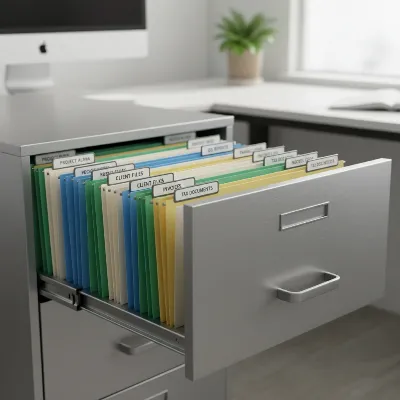 A close-up of an open 3-drawer filing cabinet with neatly arranged, color-coded files and clear labels in a modern office, showing attention to detail.
Maintaining a Pristine Filing System
The battle against clutter isn’t won with a single organization session; it requires ongoing vigilance. To keep your 3-drawer filing cabinet in top shape:
- File Immediately: The golden rule of organization is to file new documents as soon as they arrive or are processed. Don’t let papers pile up on your desk, as this is how new clutter begins.
- Schedule Regular Reviews: Set aside time, perhaps quarterly or annually, to review your files. This is when you’ll purge outdated documents, move semi-active files to archival, and ensure your system is still meeting your needs.
- Adapt Your System: Your needs might change over time. If a category is no longer useful, or if you find yourself constantly searching for certain documents, don’t hesitate to adjust your system. It should work for you, not against you.
- Consider Digital Archiving: For documents that don’t require physical retention (e.g., old utility bills after a year), consider scanning them and storing them digitally. This frees up valuable physical space and provides an additional backup.
By following these professional strategies, your 3-drawer filing cabinet will become a testament to efficiency, helping you navigate your paperwork with ease and confidence.
Frequently Asked Questions
What are the most common mistakes when organizing a filing cabinet?
Common mistakes include over-categorizing, which leads to too many folders; neglecting to purge old documents, resulting in clutter; inconsistent labeling; and failing to file documents immediately, allowing piles to accumulate outside the system.
How often should I purge my filing cabinet?
It is recommended to declutter and purge your filing cabinet at least once a year. This ensures that outdated or unnecessary documents are removed, making space for current paperwork and maintaining an efficient system.
Can I use a 3-drawer cabinet for both home and office?
Absolutely. A 3-drawer cabinet is highly versatile. You can dedicate one drawer to active work files, another to household documents, and the bottom drawer to important permanent records for both personal and professional needs.
What’s the best way to protect sensitive documents in a filing cabinet?
For sensitive documents, ensure your Filing Cabinet has a reliable lock. Additionally, consider using fireproof and waterproof file boxes or sleeves within the cabinet drawers for an extra layer of protection against environmental damage or theft.
Should I use plastic or manila folders?
Both plastic and manila folders have their benefits. Manila folders are cost-effective and easy to write on directly, while plastic folders offer greater durability and resistance to wear and tear, making them ideal for frequently accessed or long-term files.