A filing cabinet might seem like a robust, unyielding piece of office furniture, designed simply to hold documents. Yet, beneath its stoic exterior lies a potential hazard, capable of tipping over with surprising force. This isn’t just an inconvenience; a fully loaded cabinet can weigh hundreds of pounds, posing a serious risk of injury or property damage. Understanding the forces at play and implementing straightforward safety measures is crucial for transforming this everyday office staple from a silent threat into a truly secure storage solution.
The Surprising Physics Behind Tipping Filing Cabinets
At the heart of a filing cabinet’s stability, or lack thereof, is the concept of its center of gravity. When all drawers are closed and the contents are distributed evenly, the cabinet’s weight is balanced over its base, making it incredibly stable. However, this stability can quickly vanish when drawers are opened, fundamentally altering the cabinet’s weight distribution.
Imagine a tall vertical filing cabinet. When you pull out a single top drawer, especially if it’s heavy with files, the center of gravity shifts forward and outward beyond the cabinet’s base. This creates a moment of instability, pulling the cabinet off balance. The risk escalates dramatically with taller cabinets, such as four or five-drawer vertical models, where the leverage of the top drawers is significantly greater. Paradoxically, a lightly loaded cabinet can sometimes be even more unstable than a heavily loaded one, as it lacks the inherent ballast in lower drawers to counteract the forward shift. This phenomenon is often surprising, but the underlying physics are clear: any action that moves the cabinet’s center of gravity beyond its footprint can lead to a dangerous tip-over.
Common Reasons Your Filing Cabinet Becomes Unstable
Several factors can turn a seemingly stable filing cabinet into a tipping hazard. Understanding these common culprits is the first step toward creating a safer workspace.
Over-Extended Drawers
|
Our Picks for the Best Filing Cabinet in 2026
As an Amazon Associate I earn from qualifying purchases.
|
||
| Num | Product | Action |
|---|---|---|
| 1 | 2 Drawer Locking Filing Cabinet | Pre-Assembled Steel Construction | Space-Saving Design is Perfect for Home and Small Office | Letter-Size | Assembled in North America |

|
| 2 | 3 Drawer Small File Cabinet with Wheels, Farmhouse Vertical Filing Cabinet Fits Letter/A4 Size, Rolling File Cabinets Wooden Printer Stand for Home Office, Rustic White |
|
| 3 | 3 Drawer Tall File Cabinet with Wheels, Farmhouse Vertical Filing Cabinet Fits Letter/A4 Size, Rolling File Cabinets Wooden Printer Stand for Home Office, Rustic White |
|
| 4 | VASAGLE 2-Drawer File Cabinet, Small Rolling Filing Cabinet for Home Office, Printer Stand, for A4, Letter-Size Documents, 15.7 x 16.5 x 27.6 Inches, Ink Black UOFC040B16 |
|
| 5 | Letaya 3 Drawer Mobile File Cabinet with Lock,Under Desk Metal Filing Cabinets for Home Office Organizer Letters/Legal/A4((Fully Assembled-Black) |
|
| 6 | 2 Drawer Small File Cabinet with Lock, Farmhouse Vertical Filing Cabinet Fits Letter and A4 Size, Under Desk Wooden File Cabinets for Home Office, Printer Stand, Rustic White |
|
| 7 | Lorell NuSparc 3 Drawer Locking Filing Cabinet | Pre-Assembled Steel Construction | Space-Saving Design is Perfect for Home and Small Office | Letter-Size | Assembled in North America |
|
| 8 | VASAGLE 2-Drawer File Cabinet, Small Rolling Filing Cabinet for Home Office, Printer Stand, for A4, Letter-Size Documents, 15.7 x 16.5 x 27.6 Inches, Snow White UOFC040W46 |
|
| 9 | HOOBRO 2 Drawer File Cabinet with Lock, Under Desk Mobile Filing Cabinet for Home Office, Wooden Farmhouse Office Storage Cabinet, Printer Stand Fits Letter and A4 Size, Walnut and White WH66WJ01 |
|
| 10 | VASAGLE 2 Drawers File Cabinet with Lock, Printer Stand, Office Filing Cabinet Organizer, for A4 and Letter Size Documents, Ink Black UOFC061B16 |
|
The most frequent cause of tipping is opening multiple drawers simultaneously, particularly those near the top. Each drawer pulled out extends the cabinet’s center of gravity further forward. If the combined weight of the open drawers shifts the center of gravity beyond the front edge of the cabinet’s base, it will inevitably tip. This is especially dangerous when heavy files are concentrated in upper drawers, exacerbating the forward pull.
Uneven Weight Distribution
Loading a filing cabinet incorrectly can make it inherently unstable. Storing all the heaviest documents in the uppermost drawers creates a top-heavy cabinet. This shifts the overall center of gravity upwards, making the cabinet much more susceptible to tipping when any drawer is opened, even if only one. Ideally, heavier items should always be stored in the lowest drawers to provide a stable base.
Unstable Surfaces
The surface beneath your filing cabinet plays a critical role in its stability. A cabinet placed on an uneven floor, a thick plush carpet, or a sloped surface is already compromised. Carpeting, for example, can reduce a cabinet’s tip resistance by as much as 40%, as the feet can sink unevenly, creating a slight forward tilt over time. A properly leveled, firm foundation is essential for maximum stability.
Lack of Safety Features
Many older filing cabinets, or cheaper, newer models, may lack essential anti-tip safety features. Without mechanisms like drawer interlocks, which prevent more than one drawer from opening at a time, or integrated anti-tip kits, these cabinets rely solely on their inherent design and user caution, significantly increasing the risk of accidents. Workplace health and safety regulations often mandate these features for commercial use.
External Forces
Even a properly loaded and leveled cabinet can be destabilized by external forces. Bumping into the cabinet, pushing it inadvertently, or rapidly opening a drawer against its stop can introduce enough energy to initiate a tip-over. In busy office environments, these unforeseen impacts are a real concern and highlight the need for robust safety measures.
Essential Anti-Tip Mechanisms and Safety Features
Modern filing cabinets and office safety protocols incorporate several ingenious mechanisms to combat tipping. These features are designed to keep your documents – and your colleagues – secure.
Anti-Tip Kits and Wall Anchors
Perhaps the most crucial safety device, an anti-tip kit essentially anchors the filing cabinet to a wall or another stable surface. This prevents the cabinet from pitching forward beyond a safe point, even if its internal weight distribution becomes unbalanced. Installation typically involves securing a small bracket to the back of the cabinet and another to a wall stud or solid surface, connected by a strong strap or cable. These kits are not just good practice; they are often a regulatory requirement in many office and commercial settings, particularly for taller cabinets.
Anti-Tilt Locking (Drawer Interlocks)
This is a standard safety precaution in many metal filing cabinets. An anti-tilt locking system ensures that only one drawer can be opened at a time. When one drawer is extended, a mechanism locks the others, preventing a dangerous shift in the cabinet’s center of gravity caused by multiple open drawers. This feature is a requirement for workplace health and safety in many jurisdictions and is a strong indicator of a safe cabinet design.
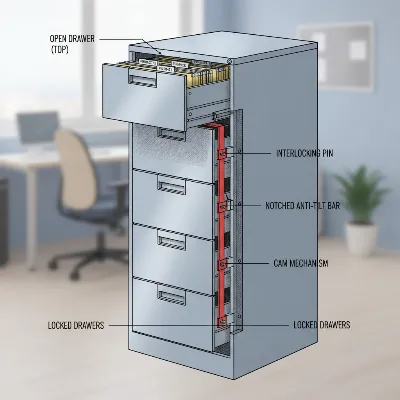 An illustration showing a cutaway view of a filing cabinet with an anti-tilt locking mechanism engaged, preventing multiple drawers from opening.
Outriggers and Stabilizers
Some advanced filing cabinet designs incorporate outriggers or other stabilizing elements. These features effectively enlarge the cabinet’s footprint, thereby improving its resistance to overturning. Passively deployed outriggers might extend from the base when a drawer is opened, or the cabinet might have a wider, more stable base by design. These enhance stability by providing a broader foundation against forward tipping.
Integrated Counterweights
While less common in standard office filing cabinets, some designs, particularly those with deep or heavy drawers, may include integrated counterweights at the rear or base. These weights provide a constant downward force, helping to offset the forward momentum created when drawers are extended and keeping the cabinet balanced.
5th Wheel on Mobile Units
For mobile drawer units that include a file drawer, a “5th wheel” is an innovative stabilizing feature. This small, centrally located wheel on the bottom of the cabinet or attached to the bottom file drawer extends when a drawer is opened, rolling along the floor to stabilize the entire unit and prevent it from tipping forward.
Practical Steps to Prevent Filing Cabinet Tipping
Ensuring your filing cabinets remain upright and safe requires a combination of smart setup, careful usage, and proactive maintenance.
Proper Loading and Organization
This is perhaps the simplest yet most effective safety measure. Always load the heaviest items into the lowest drawers first. This keeps the cabinet’s center of gravity as low as possible, significantly improving its stability. Distribute the remaining contents evenly among the other drawers, avoiding concentrating all your files in the top sections. Never overstuff drawers, as this can impede their smooth operation and contribute to instability. Regularly cleaning out outdated or unnecessary files can also prevent overfilling and maintain balance.
Operating Safely
Cultivate the habit of opening only one filing cabinet drawer at a time. This is fundamental, especially for cabinets without an anti-tilt interlock system. Before closing a drawer, ensure your fingers are clear of the edges to prevent pinching. In crowded areas, always be mindful of others before opening a drawer to prevent accidents.
Ensuring a Level Surface
Filing cabinets must be installed on a hard, level surface. If your office floor is carpeted or uneven, use shims to level the cabinet. A thick Masonite sheet placed underneath the cabinet can provide a proper, stable base on carpeted floors, preventing the cabinet from sinking unevenly over time. Use a spirit level to confirm the cabinet is perfectly upright and stable.
Securing the Cabinet
For maximum safety, anchor single filing cabinets to a nearby wall stud or another secure fixture using an anti-tip kit. If you have multiple filing cabinets side-by-side or back-to-back, consider “ganging” or bolting them together. This creates a larger, more stable unit that is far less likely to tip than individual cabinets. While bolting can restrict relocation, it almost completely eliminates the risk of tipping.
Regular Maintenance
Ensure all drawers slide smoothly and that any safety mechanisms, like drawer interlocks, are functioning correctly. Address issues like sticky drawers or faulty locks promptly, as these can contribute to instability or create new hazards. Check that the cabinet remains level periodically, especially if it’s on a surface prone to settling.
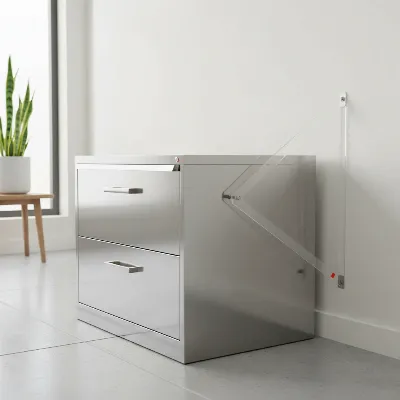 An image showing a modern metal filing cabinet securely anchored to a wall with an anti-tip strap, demonstrating proper office safety.
Choosing a Safe Filing Cabinet: What to Look For
When investing in new filing cabinets, prioritizing safety features can save you from future headaches and potential accidents. Look for these key attributes:
- Built-in Anti-Tilt Mechanisms: This is paramount. A cabinet with a drawer interlock system ensures that only one drawer can be opened at a time, drastically reducing the risk of tipping. This feature is often found in quality metal cabinets and is a non-negotiable for many workplaces.
- Inclusion of Anti-Tip Kits: Many reputable manufacturers now include anti-tip kits with their taller cabinets, recognizing the importance of wall anchorage. Check if one is provided and if the cabinet design allows for easy installation.
- Robust Construction and Stability: Examine the cabinet’s overall build. Heavier-gauge steel, a wider base, and solid, well-constructed drawers contribute to inherent stability.
- Compliance with Safety Standards: Reputable manufacturers will often adhere to national or international safety standards regarding furniture stability. Look for certifications or mentions of compliance in product specifications.
The Cost of Neglect: Risks and Liabilities
Ignoring the potential for a filing cabinet to tip over carries significant risks, extending beyond just a mess of scattered documents.
- Personal Injury: The most severe consequence is personal injury. A 200 lb. filing cabinet can strike the floor at speeds up to 13 mph, capable of causing severe crushing injuries, broken bones, or even fatalities. Fingers can also be painfully smashed if caught in closing drawers.
- Property Damage: Beyond human harm, a falling cabinet can damage office equipment, walls, and the floor, leading to costly repairs and disruptions.
- Workplace Safety Regulations and Compliance: In commercial settings, employers have a legal and ethical obligation to provide a safe working environment. Non-compliance with occupational safety standards regarding furniture stability can result in hefty fines, legal action, and a damaged reputation. Implementing safety measures isn’t just good practice; it’s often a legal requirement.
> “Never underestimate the danger of a heavy filing cabinet. The perceived stability when closed can be misleading; proactive measures are vital for preventing serious workplace accidents.” – Dr. Eleanor Vance, Ergonomics and Office Safety Consultant
Conclusion
The filing cabinet, a seemingly innocuous item, holds a hidden potential for danger if not properly managed. Understanding that factors like over-extended drawers, uneven weight distribution, and unstable surfaces can shift its center of gravity is the key to preventing accidents. By embracing solutions such as anti-tip kits, anti-tilt drawer interlocks, proper loading techniques, and ensuring a level installation, you can transform this essential office tool into a genuinely secure component of your workspace. Prioritizing these safety measures not only protects your valuable documents but, more importantly, safeguards the well-being of everyone in your office.
Have you ever experienced a near-miss with a tipping filing cabinet, and what measures did you take afterward?
Câu Hỏi Thường Gặp
Why is my filing cabinet unstable even when empty?
Even an empty or lightly loaded filing cabinet can be surprisingly unstable because it lacks the ballast in lower drawers to counteract the forward shift of weight when an upper drawer is opened. The center of gravity can still extend beyond its base, making it prone to tipping if not properly secured or if multiple drawers are opened.
Can I anchor a filing cabinet to drywall?
Anchoring directly into drywall is generally not sufficient, as drywall alone cannot support the weight and force of a tipping cabinet. You must secure the anti-tip kit or fastener into a wall stud or other solid structural element behind the drywall to ensure effective and reliable anchorage.
How do I know if my cabinet has an anti-tilt mechanism?
To check for an anti-tilt mechanism, open one drawer fully. Then, try to open another drawer. If the second drawer remains locked and cannot be opened while the first is extended, your cabinet has an anti-tilt or interlock safety feature.
Is it okay to put a heavy printer on top of my filing cabinet?
No, it is strongly advised against placing heavy items like printers on top of your Filing Cabinet. This makes the cabinet top-heavy, significantly raising its center of gravity and increasing its instability, making it much more likely to tip over when drawers are opened, even with safety features in place.